



The Dover boat
Discovered in 1992 at a depth of seven meters during roadworks leading to the port of Dover, this Bronze Age boat immediately aroused the enthusiasm of the archaeological community. Thirty-three years later, this sewn boat, dated to 1550 BC, is considered one of the greatest archaeological discoveries of the XXe century, and one of the oldest known sea-going boats in the world.
The careful study of its construction elements, combined with specialist analysis, has resulted in a major scientific publication, led by Peter Clark, archaeologist at the Canterbury Archaeological Trust, who has devoted much of his career to the study of this craft. The boat's wood was stabilized by treatment with water-soluble wax impregnation, followed by freeze-drying in the laboratories of the Mary Rose Trust in Portsmouth.

The "BOAT 1550 BC"
project
Under the direction of Peter Clark, an ambitious research program has been launched around the reconstruction and experimentation at sea of the Dover ship. To this end, Clark collaborated with researchers from the University of Lille III and the University of Ghent. This cross-Channel cooperation led, in 2011, to European funding as part of the project entitled "BOAT 1550 BC".
This project aimed to explore the cultural links between Bronze Age coastal communities established in Kent, Belgian Flanders and Pas-de-Calais, united by shared maritime practices. One of its major achievements was the traveling exhibition "Beyond the Horizon: Societies in the English Channel and North Sea, 3500 years ago", presented in the three partner countries, around a 1:2 scale replica of the Dover ship.
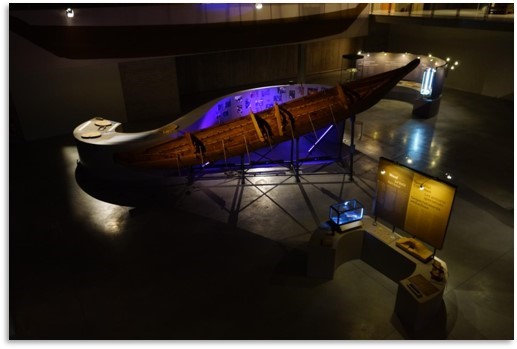
The 1:2 scale replica
The replica was designed by Ole Crumlin-Pedersen, an internationally recognized specialist in naval archaeology, and built by Richard Darrah and a team of archaeological timber experts. Materials were sourced from oak trees felled in France and the UK. Construction, completed in the early months of 2012, scrupulously respected the use of Bronze Age techniques and tools, reproducing the sewn structure and details of the original boat. Missing elements - the upper planks and ends - have been interpreted by the team according to the available data.
The first launch, in May 2012, was a failure due to insufficient caulking. But in September 2013, after being repatriated to Dover and re-sealed using a mixture of dry vegetable foam and animal fat, the replica successfully completed a freshwater sail near Canterbury, followed by its first sea trial in the port of Dover.
The replica was launched in the port of Dover in September 2013
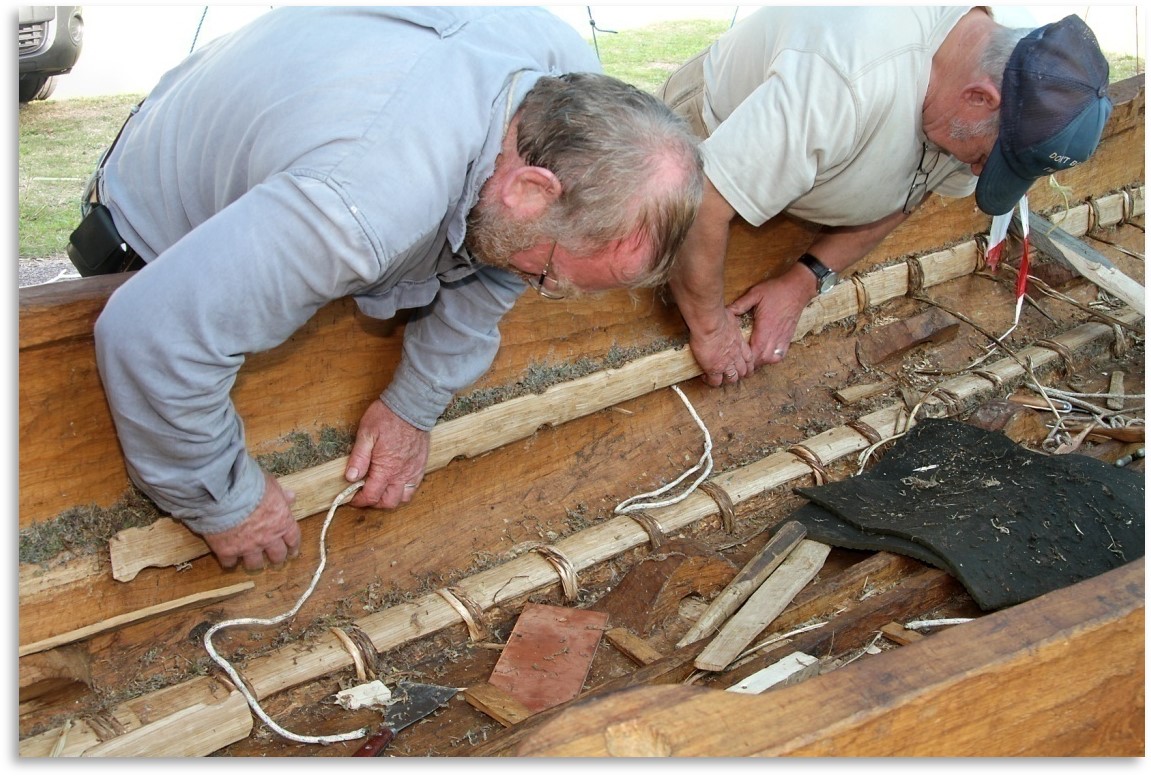
The journeys of the replica
Since this successful launch, the replica has been regularly used in spring and summer by teams of archaeologists and volunteers enthusiastic about paddling in the port of Dover. Longer sailings were carried out between Folkestone and Dover, as well as between Saint-Vaast-la-Hougue and the Normandy island of Tatihou. The replica was also presented at several maritime festivals in the UK, France and Belgium, and took part in two editions of the Great River Race on the Thames in London.

The replica enters the museum
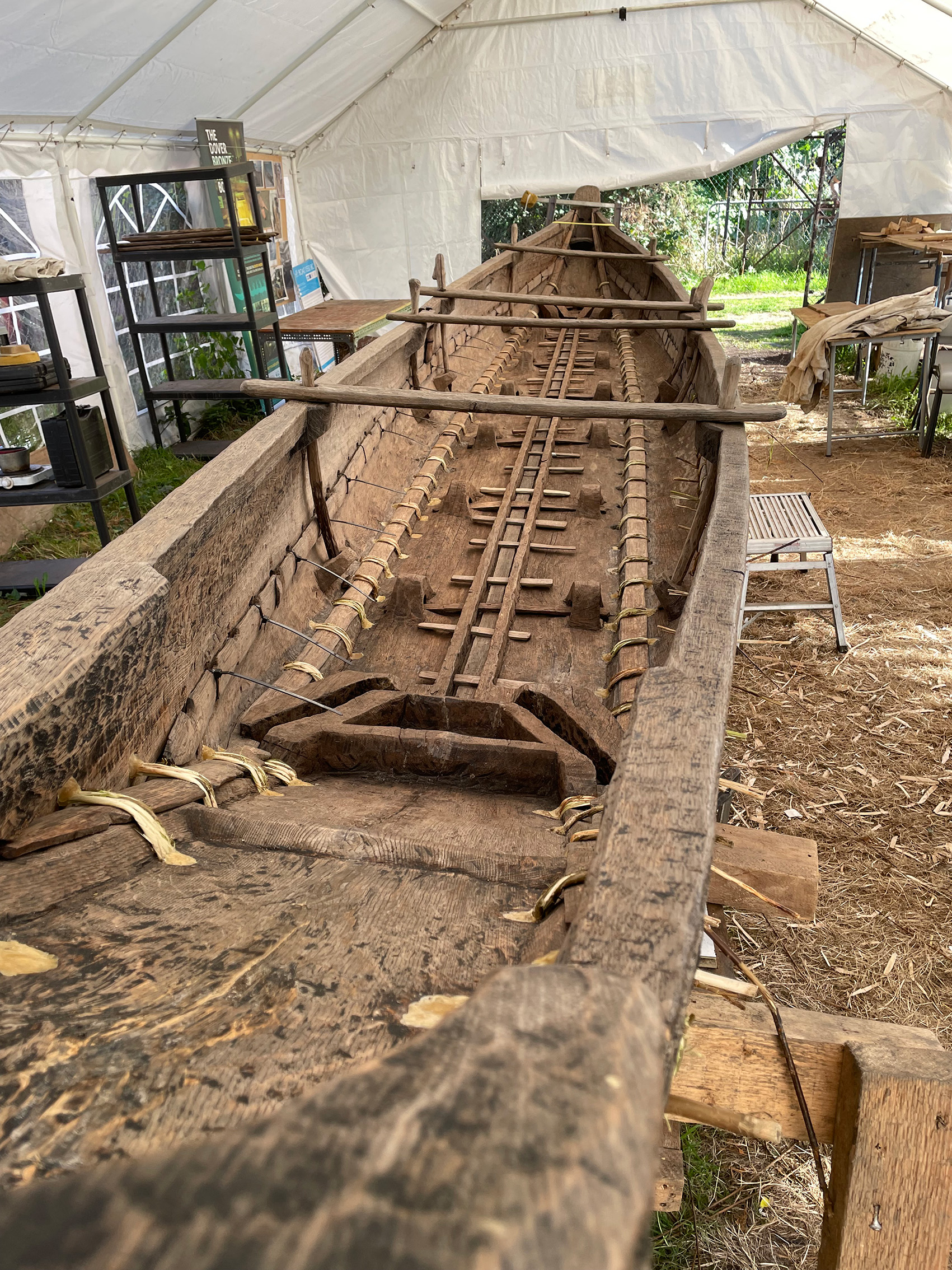
After more than ten years of experimental sailing, the Dover ship replica has completed its active career. In 2024, its restoration and transformation into a permanent exhibition piece was made possible thanks to the support of SAMAN (Société des Amis du musée d'Archéologie nationale), as part of the exhibition Les Maîtres du Feu: l'âge du Bronze en France (2300-800 av. J.-C.)". Restoration work was carried out in Dover in the second half of 2024.


Further information



To discover
The Fire Masters
Exhibition from June 13, 2025 to March 9, 2026

Bronze 150
2025: the Year of Bronze

Archaeologists unveil the Bronze Age
Exhibition in the national domain