


Sailing in the Bronze Age
Boats from Ferriby, Dover and Zambratija
Sailing and maritime exchanges in Europe and the Mediterranean are a key element of the exhibition The fire masters presented at the MAN from June 13, 2025 to March 9, 2026.
Three sewn boats, three European maritime traditions from the Bronze Age, three examples of navigation are thus exhibited through three major wrecks, Zambratija (Croatia), Dover (England) and Ferriby (England), which trace the emergence and diversity of naval technical traditions in Europe during the 2nd millennium BC. All three have the distinctive feature of being sewn boats, i.e. built without nails or metal fastenings, but with vegetable or natural fiber ligatures. Their differences are as significant as their commonalities.
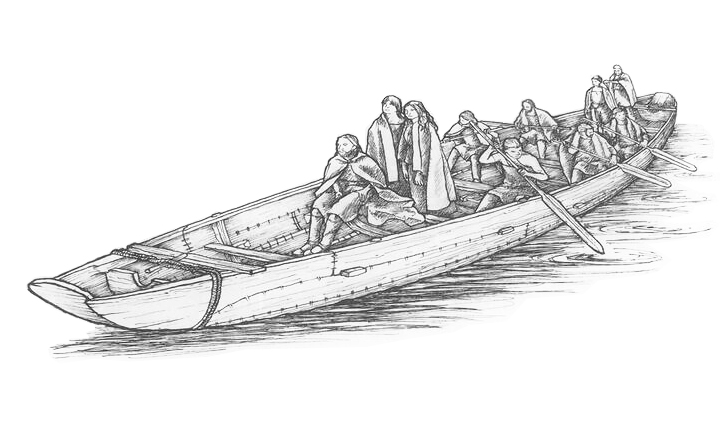
Ferriby: pioneers of the estuary
The Ferriby shipwrecks, five in all, were discovered between 1937 and 1989 on the north bank of the Humber estuary in Yorkshire, England. Dating from 2030 to 1680 BC, they are the oldest sewn plank boats in Europe. Built from oak planks, they originally measured almost 16 meters in length, with a maximum beam of around 2.5 meters. They featured curved shapes, a box scarfing joint to form a keel, and the planks were fitted in a sophisticated construction tradition and sewn together with thick rope made from soft, strong willow twigs, still used today in basketry. Gaps were caulked with foam. Couples and crosspieces added rigidity to the whole.
These boats were probably used to transport goods, such as amber and metals that were traded in the North Sea and English Channel, The builders of these boats were at once technicians, sailors and pioneers. Their assembly style indicates advanced technical mastery and significant community investment, to be linked to a regional economy structured as early as the Early Bronze.
To find out more, read the following articles
Zambratija: a sewn Mediterranean boat
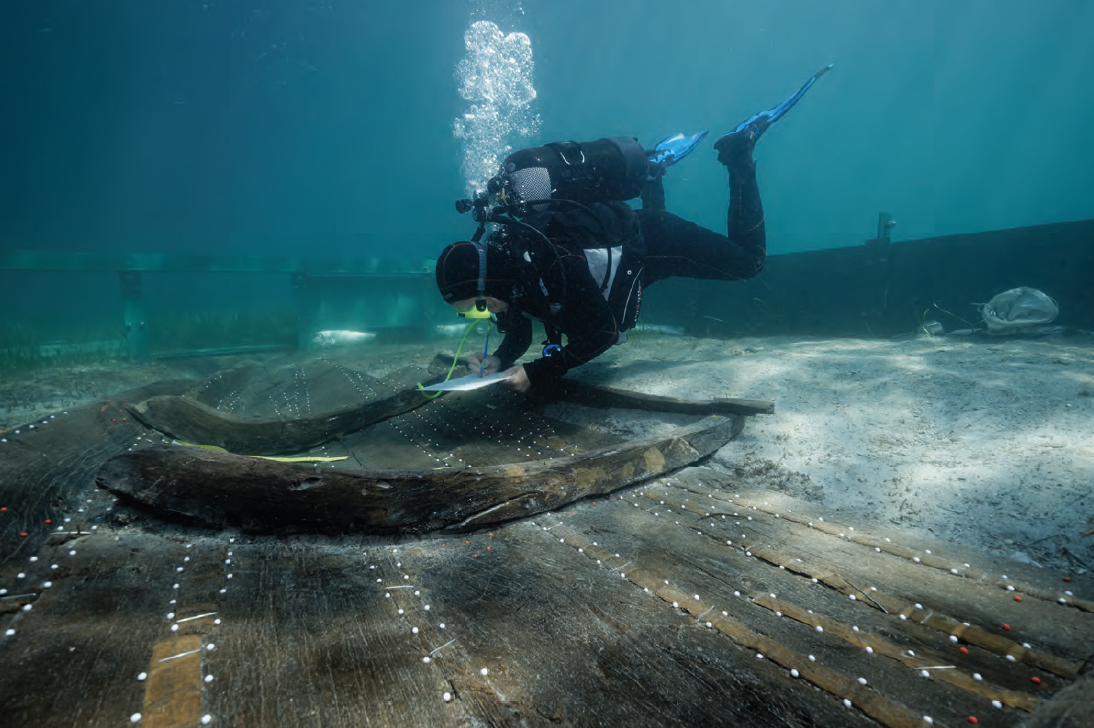
The wreck of Zambratija, discovered in 2008 on the northwest coast of the Istrian peninsula near Umag, Croatia, was found some 150 meters from shore in Zambratija Bay. It has been dated to between 1264 and 1056 BC, making it the oldest known sewn boat in the Mediterranean. Its currently preserved size is 6.7 meters long, with a maximum beam of 1.6 meters. This is, however, an incomplete portion of the boat; its original length must have been greater, but is not yet precisely estimated in the present state of research
Assembled entirely without nails or metal, Zambratija's boat is made of elm planks sewn together with plant fibers, caulked with an organic material, and reinforced with fir elements. The absence of a keel, the flat structure and the probable use of paddles make this boat perfectly suited to shallow coastal or lagoon waters. Underwater excavations carried out between 2008 and 2013 recorded the wreck using photogrammetry and revealed a construction technique unique to the Adriatic. The site has been protected since 2010.
This boat, which may have carried up to 15 people, bears witness to an original protohistoric maritime tradition and active trade with Italy and the Aegean in the late Bronze Age.
To find out more, read the following articles
Dover: the sewn masterpiece of the English Channel
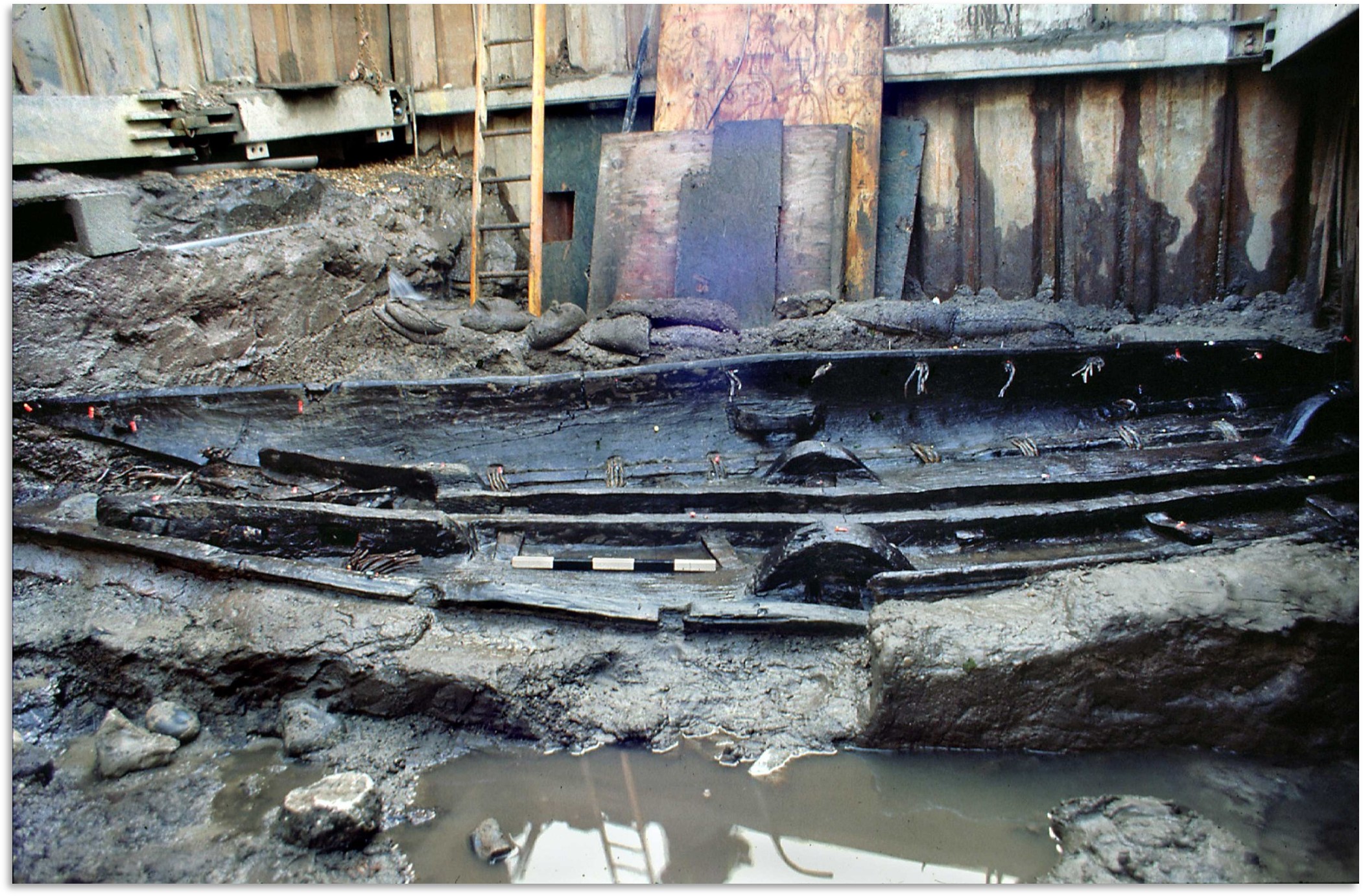
The Dover boat, was discovered in 1992 during construction work in the town center. It is dated to 1550 BC and is the most complete example of an oceanic sewn boat. This oak boat features a complex sewing technique, with oblique seams, foam caulking and a transverse bulkhead. It bears witness to an ocean-going tradition that suggests sustained cross-Channel trade and the existence of a genuine protohistoric maritime community between Kent, Flanders and Pas-de-Calais. Its study was completed by the construction of a replica, which made it possible to test its navigability in the English Channel. It can now be seen in the courtyard of the Château de Saint-Germain-en-Laye
To find out more, read the following articles
These three boats illustrate the same technical solution (the sewn plank system), developed independently or in parallel in different contexts around the English Channel, the North Sea and the Eastern Mediterranean.
The sewn boat is not an archaic technique, but an efficient choice adapted to specific environments (soft woods, absence of metal, smooth sailing).
To discover
The Fire Masters
Exhibition from June 13, 2025 to March 9, 2026

Bronze 150
2025: the Year of Bronze

Archaeologists unveil the Bronze Age
Exhibition in the national domain
