



Roman Gaul
Julius Caesar's conquest of Hairy Gaul at the beginning of the second half of the 1st century BC is considered to be the starting point of a profound political, economic and social transformation: its Romanisation.
Julius Caesar's conquest of Hairy Gaul at the beginning of the second half of the 1st century BC is considered to be the starting point of a profound political, economic and social transformation: its Romanisation. After a long phase of pacification, Gaul, integrated into the Roman Empire, was organised mainly by the emperor Augustus, who reigned from 27 BC to 14 AD.
The material civilisation, which the department of Roman Gaul makes it possible to discover, underwent gradual changes, and reflects the assimilation, to a greater or lesser extent depending on the region, social milieu or period, of customs, techniques, ways of life and thought of Roman or Mediterranean origin. This contribution, sometimes mixed with the heritage of the previous period, contributed to the creation of an original and dynamic provincial Roman civilisation, the Gallo-Roman civilisation.
The seven rooms that make up the Gallo-Roman department evoke the world of the gods and the dead, the presence of the Roman army in Gaul, the different types of crafts and all aspects of daily life: food, costume, adornment, leisure activities, the domestic environment, medicine, transport, writing...
Les objets
Statuette
Divinité de Bouray-sur-Juine
Bouray-sur-Juine (Essonne)
Fin du Ier s. av. J.-C. - début du Ier s. après J.-C. ?

Sculpture
Pilier aux quatre dieux
Paris, Pont-au-Change
Ier siècle

Statuette
Statuette of Mercury
This bronze statuette of Mercury shows him in his most classical appearance: a nude young man with a chlamys (travellers cloak) on his shoulder, the winged petasus on his head, small wings on his heels, and holding the caduceus. The animals that normally accompany him, cockerel, ram and tortoise, are missing.The Roman god Mercury was particularly popular in Roman Gaul, especially in the centre, north and east of the country. He protected traders, traveller and foreigners, and unusually, artisans too, although this was peculiar to Gaul.The powers of the Gallo-Roman Mercury, therefore, were more extensive, and perhaps reflect the partial assimilation of the Greco-Roman divinity into one or several Celtic deities. The statuette, like others in terracotta and silver, probably belonged to a small domestic chapel, where religious rites were carried out, even though Mercury was also worshipped in major sanctuaries, sometimes located on hilltops like the Puy de Dôme.

Stèle
Stèle funéraire d'Apinosus Iclius
Entrains (Nièvre)
IIe siècle

dépôt
Dépôt funéraire d'un d'officier romain
Chassenard (Allier)
Vers 40 ap. J.-C.

Sculpture
Sculpture d'un couple sur un lit
Bordeaux (Gironde)
Fin IIe - début IIIe siècle ap. J.-C.

Mosaïque
Mosaîc Floor
The mosaic, over a third of which is missing, decorated the floor of a large suburban villa in Saint-Romain-en-Gal, one of the areas of Vienne in ancient times. It was one of the most beautiful and most prosperous towns in Gaul. Mosaic workshops were set up in Vienne to satisfy the demands of a wealthy clientele.Agricultural and rural activities, and the festivals of the four seasons are depicted in 40 panels surrounded by a rich braided border. 27 of these survive, each measuring 59 cm. This theme was not generally used by mosaicists, and particularly not by the workshops of Vienne, which preferred to depict mythological scenes or still lifes. They were inspired no doubt by one or several of the Roman examples found throughout the Mediterranean region, but this mosaic could also well be regarded as a “reportage” on Gallo-Roman agricultural practices.The images are set around four central panels depicting personifications of the seasons: Winter is a woman wrapped in a cape on a wild boar, Spring is a nude Cupid on a bull, Summer is a nude Cupid on a lion, and Autumn is a nude Cupid on a tiger.

Bijoux
Bagues d’un trésor du IIIe siècle
Nizy-le-Comte (Aisne)
Vers 211-212

Sculpture
Fragment d'une tête
Reims (Marne) (?)
IIe - IIIe siècle (?)

Statuette
La statuette d’Attis
Lieu-dit La Lagaste, commune de Rouffiac-d'Aude (Aude).
IIe siècle

Accessoires du costume
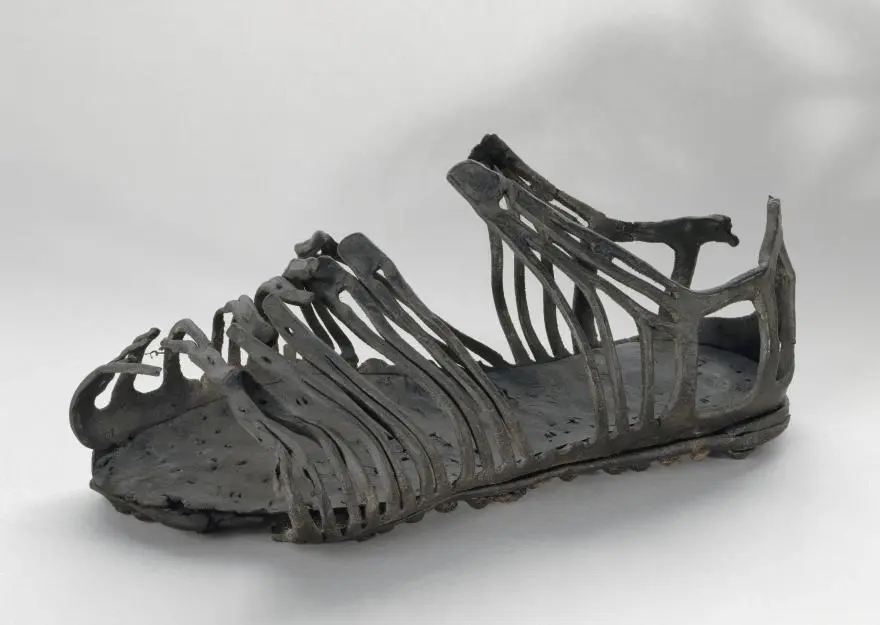
Chaussure de soldat romain
Mayence (Allemagne)
Ier siècle apr. J.-C.
Instrument de musique
Flûte de pan
France (?)
IIe siècle - IIIe sièce après J.-C. (?)
