

From castle to museum
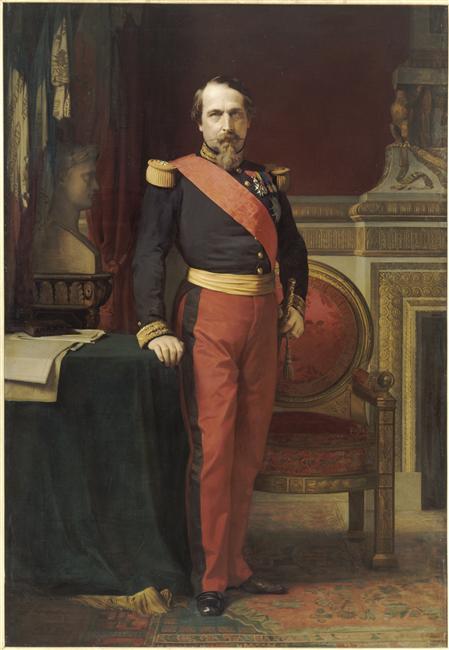
Napoleon III's passion for archaeology
The Château de Saint-Germain-en-Laye, a royal residence appreciated by sovereigns since the Middle Ages, was restored by Eugène Millet in 1862. Since then, on the initiative of Napoleon III, it has housed the Gallo-roman Museum, which became the Musée des Antiquités nationales in 1879, then the Musée d'Archéologie nationale in 2005.
View the film presenting the facility
A museum in a castle
Vacated in 1682 by Louis XIV, the former royal residence of Saint-Germain-en-Laye gradually fell into disrepair in the 18th and 19th centuries. In 1862, Napoleon III decided to create a museum dedicated to archaeology on the site of a former military penitentiary.
By the Second Empire, the château was in an advanced state of disrepair. In 1862, Napoleon III commissioned Eugène Millet, a pupil of Eugène Viollet-le-Duc, to restore the building to house the Gallo-Roman Museum. The emperor, who was fascinated by the figure of Julius Caesar, wanted to provide an exceptional setting for objects discovered during excavations at Alise-Sainte-Reine, Puy-d'Issolud and Bibracte. His aim was to glorify Caesar's military actions at Alesia, Avaricum and Uxelludunum during the Gallic War, and pay tribute to the greatness of the Roman legions. The collections donated to the museum by amateur collectors and archaeologists soon expanded beyond the Gaulish War and the Gallo-Roman world.
A Pharaonic construction site
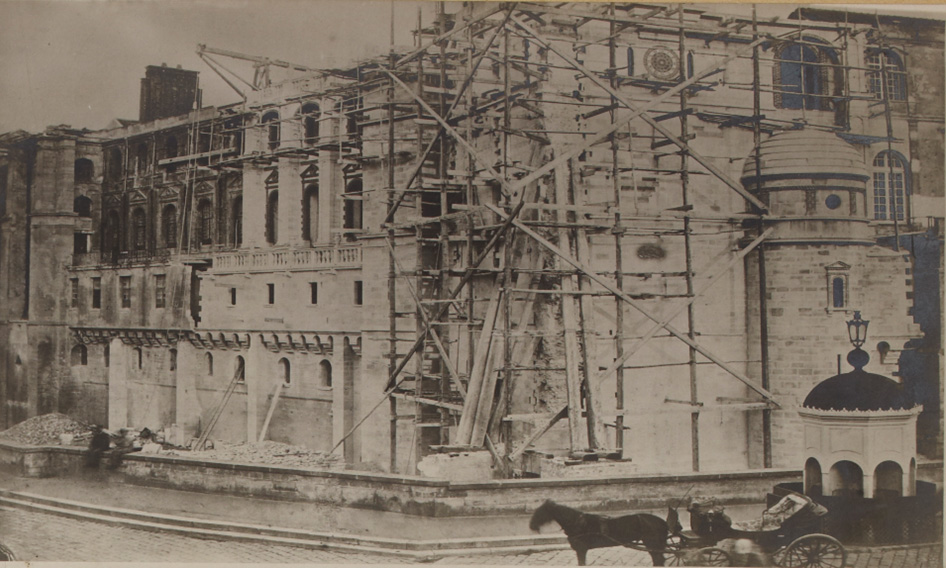
Classified as a historic monument as early as 1862, when restoration work began, it was decided to restore the royal edifice to its Renaissance state, as designed by François I and Henri II. This involved demolishing the pavilions built by Jules Hardouin-Mansart at the request of Louis XIV. The keep and royal chapel also had to be cleared. At the same time, the rooms of the new museum were designed. This colossal project was not completed until 1907. Nevertheless, Napoleon III, in a hurry to open this museum of national importance, inaugurated its first seven rooms on May 12, 1867, right in the middle of the work.
The creation of the Gallo-Roman Museum
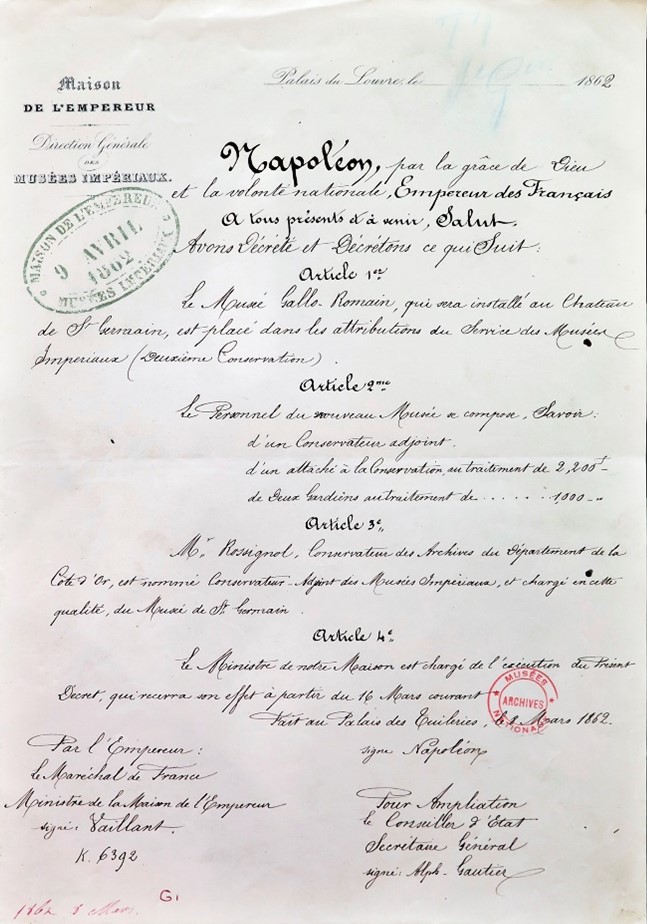
The long-awaited museum was created by imperial decree on March 8, 1862. Its conception mobilized the scholarly world both in Paris and in the provinces.
The project for a museum dedicated to the nation's history from the earliest times to Charlemagne, and based on the material evidence produced by archaeology, was born at the end of 1864. It was spearheaded by Auguste Verchère de Reffye, Napoleon III's officer-in-charge, who was passionate about Roman weaponry and archaeology.
Once the project had been adopted by the Emperor, an advisory commission for the organization of the museum was set up to define precise objectives and design the collections and their presentation. Headed by Count Émilien de Nieuwerkerke, Superintendent of Fine Arts and Director of the Imperial Museums, it brought together 16 personalities renowned for their scientific knowledge in the fields of history, architecture, geology, geography, epigraphy, numismatics, paleontology and archaeology.
Thus, from April 1865 to spring 1866, Auguste Verchère de Reffye, Adrien de Longpérier, Paul Broca, Alexis Damour, Jules Desnoyers, Claude Rossignol, Octave Penguilly-L'Haridon, Eugène Viollet-le-Duc, Casimir Creuly, Alfred Maury, Édouard Lartet, Félicien de Saulcy, Alexandre Bertrand and Anatole de Barthélémy designed a museum that was very different from other national museums, a "museum worthy of science".
- Report submitted to Napoleon III in 1866
-
In the report submitted to Napoleon III in 1866, it was decided that "the main aim of the selection of objects, their classification and the written explanations accompanying them should be to show, as far as possible, the successive state of industry and the arts at various periods in the development of mankind, constantly modified by the progress of time and the influence of migrations and trade relations. [...] ". The method of classifying objects is "by distinct excavations and by provenance [...] Geographical classification, or rather topographical classification, will thus complement the classification by excavation [...] A large room of comparison or analogies, which would contain, in series and in an order that is as chronological as possible, all objects of the same nature, whether they come from Gaul or from abroad, would succeed the excavation rooms [...]". The museum thus set itself apart from museums devoted to the fine arts, such as the Louvre, and was intended to be highly didactic.
The Commission de Topographie des Gaules, set up in 1858 at the instigation of Napoleon III, played an important role in the organization of the museum and the enrichment of its collections, through its links with learned societies and its work, which was abundantly displayed in the galleries.
Under the Third Republic, the national museum reform of 1878 led to a change in the museum's name to "Musée des Antiquités nationales".
A museum linked to the history of archaeology
The history of the Musée d'Archéologie Nationale is inseparable from that of the great collections formed by the first archaeologists and prehistorians, and from the development of French and European archaeology. Among the very first collections to be entered were those of Jacques Boucher de Perthes, built up from his excavations in and around Abbeville (Somme), which revealed the existence of a prehistoric humanity predating that of the Gauls.
The collections of Édouard Lartet, Frédéric Moreau, Joseph de Baye, Édouard Piette and Paul du Chatellier, which joined the museum in the 19th and 20th centuries, contributed to its renown.
The development of prehistory in France underwent an extraordinary expansion, thanks to the fundamental work of Gabriel de Mortillet, appointed curator of the museum in 1868. The author of a chronology of prehistory based on the classification of lithic industries, de Mortillet illustrated his scientific ideas through museography, making the museum a center of excellence for prehistory and protohistory.
The field of comparative archaeology is marked by the personality of Henri Hubert, who joined the museum in 1898. His creation of a room devoted to the "ethnographic history of Europe and mankind" from its origins to the early Middle Ages, adopts a sociological approach to archaeology.
Finally, the most renowned archaeologists of the late 19th century and the first half of the 20th century, including Joseph Déchelette, Ernest Chantre, Abbé Breuil, Louis Capitan, Abbé Philippe and Jacques and Henri de Morgan, will share their knowledge and experience with the teams at the national museum.
Le museum today
New collections are constantly being added to the Musée d'Archéologie Nationale. Donations, purchases at public auctions and from specialized galleries perpetuate the traditional ways in which objects are acquired. The collections also come from current research carried out in France and abroad. Examples include the extraordinary series of objects from New Guinea, collected by Pierre Pétrequin, and the exceptional furniture from the Gallic chariot tombs at Roissy airport, discovered in 1995 as a result of rescue excavations.
Constant links with regional archaeology departments, its status as a Grand Département, its role as coordinator of the Archéomuse network and its role as a disseminator of archaeology in museums through its publications make the Musée d'Archéologie Nationale a recognized player in research, heritage conservation and public outreach.
Discover the collections of the Musée d'Archéologie Nationale
Watch the museum history video